

The following is a list of events, deals, and attractions near the inn from "Sangimi no Yado".
Tanzan Shrine’s Kemari Festival [Plenty of Photos! ]
2025.09.09
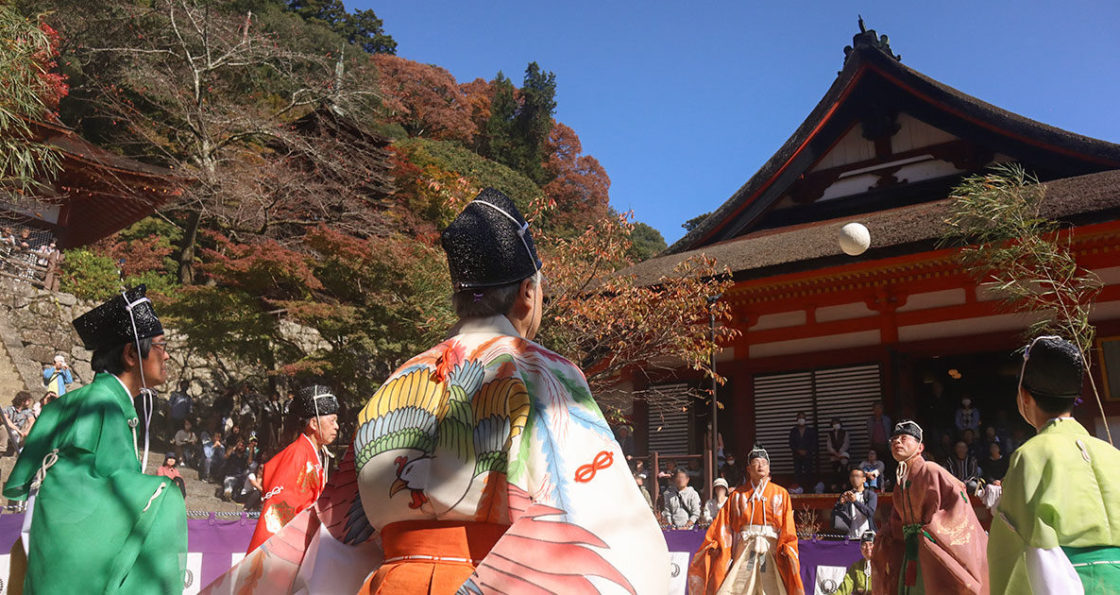
Cherry blossoms in spring, Maple leaves in autumn. A white ball dances in the elegant garden.
Tanzan Shrine, an ancient temple nestled in the mountains of Tōno Mine in eastern Asuka.
Renowned as Nara Prefecture’s premier spot for cherry blossoms and autumn foliage, its grounds display breathtaking beauty throughout the seasons, earning it the nickname “Nikko of the West.”
Tanzan Shrine hosts the Kemari Festival twice yearly, in spring and autumn.
Why not come witness the spectacular kemari matches performed by players clad in vibrant costumes?
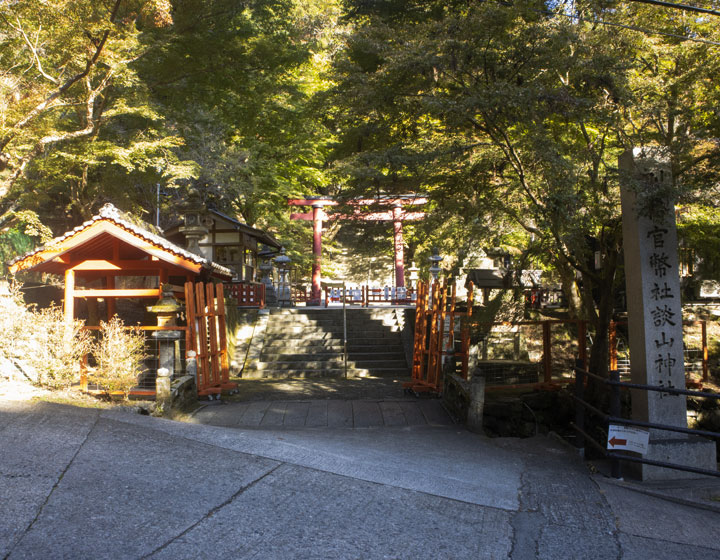
Tanzan Shrine Entrance
Contents
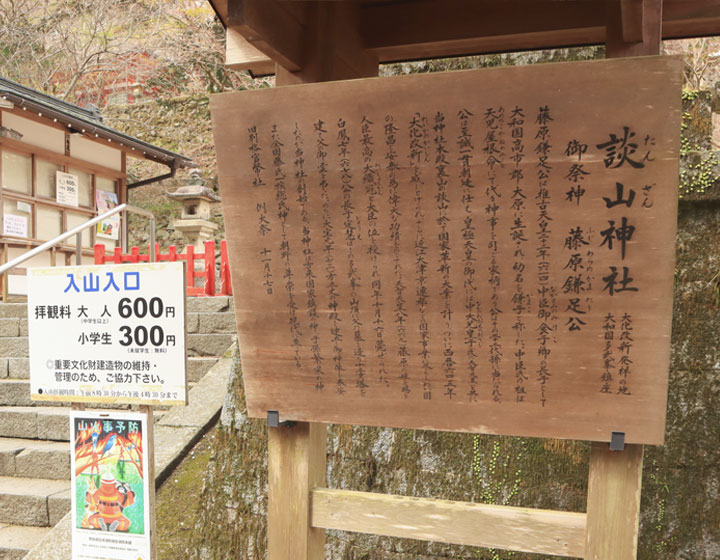
The shrine atop the mountain dedicated to Fujiwara no Kamatari.
The mountain where the key figures of the Taika Reform gathered to discuss.
-
Tanzan Shrine is located at “Tōno Mine,” which refers to a mountain in the southern part of Sakurai-shi, Nara Prefecture, and the temples that once stood in the surrounding area. Before the separation of Shinto and Buddhism, this site housed the temple Tōno Mine Myōraku-ji.
Today, Tanzan Shrine is renowned as a prime spot for viewing cherry blossoms and autumn foliage.
The name originates from the secret meeting held atop this mountain by Prince Naka no Ōe and Nakatomi no Kamatari.
Furthermore, the Kemari Festival held at Tanzan Shrine is also performed in observance of the legend surrounding their encounter.
The Isshi Incident and the Dawn of the Taika Era.
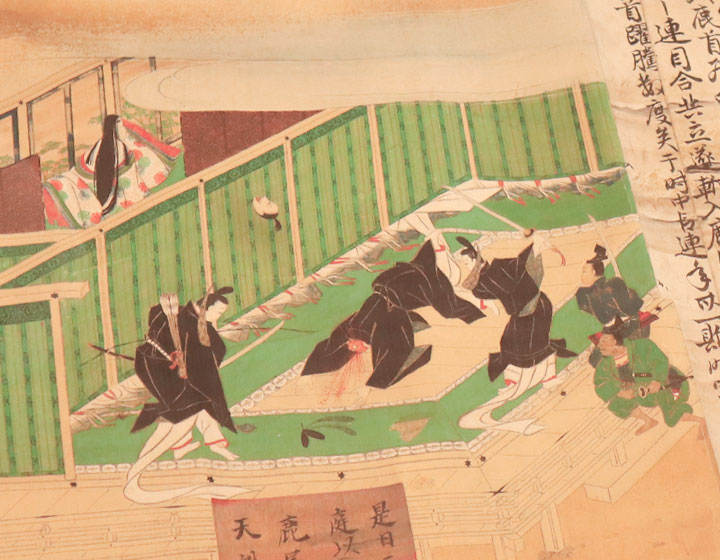
- When Prince Shōtoku, the regent, died in 622, powerful clans grew in influence. Among them, the Soga clan—led by the father and son, Emishi and Iruka—reigned supreme, ruling the empire as they pleased, even bypassing the emperor.
Nakatomi no Kamatari (later Fujiwara no Kamatari), alarmed by the Soga clan’s violent actions, met Prince Naka no Ōe (later Emperor Tenji) at a kemari gathering at Hōkō-ji Temple (present-day Asuka-dera Temple).
The two deepened their friendship, climbed a mountain, and held secret talks to overthrow the Soga regime.
This mountain later came to be called “Katarai-yama” and “Danjo-no-mori,” which became the origin of the name of Tanzan Shrine.
Prince Naka no Ōe and Nakatomi no Kamatari subsequently destroyed the Soga clan in Japan’s first coup d’état, the Isshi Incident, in the fourth year of Empress Kōgyoku’s reign (645).
This series of national reforms following the Isshi Incident is known as the Taika Reform.
The subsequent rise of Kamatari and the beginnings of the Fujiwara clan.
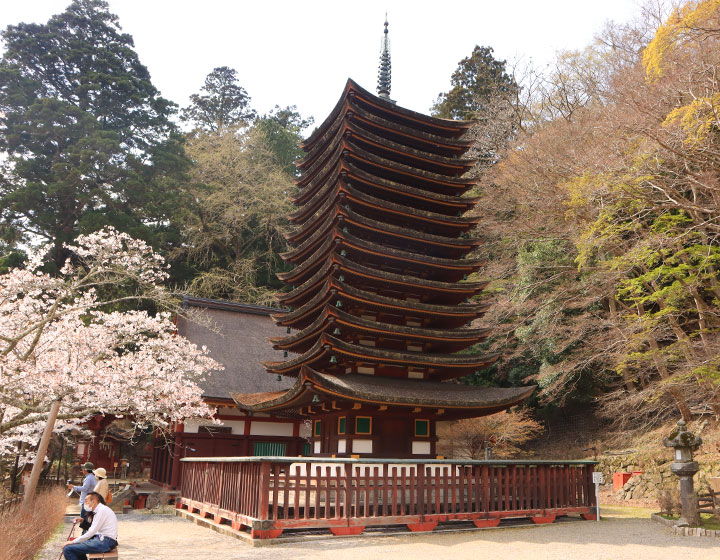
- Prince Naka no Ōe remained Crown Prince for a long time without ascending the throne, ruling in his name. After suffering a crushing defeat at the Battle of Hakusukinoe, he moved the capital to Ōtsu Palace in Ōmi (present-day Ōtsu-shi) and ascended the throne, becoming Emperor Tenji.
In the eighth year of Emperor Tenji’s reign (669), Nakatsukasa no Kamatari was granted the surname “Fujiwara” by Emperor Tenji while visiting him on his sickbed, and thus became known as Fujiwara no Kamatari.
Furthermore, he was granted the highest ministerial title and position, appointed as Minister of the Interior, but Kamatari passed away the following day.
He was subsequently buried in Awai, Settsu Province (present-day Ibaraki-shi, Osaka Prefecture). However, in the seventh year of the Hakuhō era (678), his eldest son, the monk Jōe (also spelled Jōkei), returned from Tang China and relocated Kamatari’s grave to Mt. Tōno. A thirteen-story pagoda was erected atop the grave, marking the origin of Tanzan Shrine.
Enjoy the Kemari Festival at Tanzan Shrine!
I went to see the autumn kemari festival.
At Tanzan Shrine, the Kemari Festival is held annually on Showa Day (April 29) and Culture Day (November 3).
This event offers the chance to witness the skill of players clad in colorful costumes against the backdrop of the shrine grounds—beautiful with fresh greenery in spring and newly colored autumn leaves in fall.
This time, we bring you a report on viewing the autumn Kemari Festival.
From the parking lot to the entrance of Tanzan Shrine.
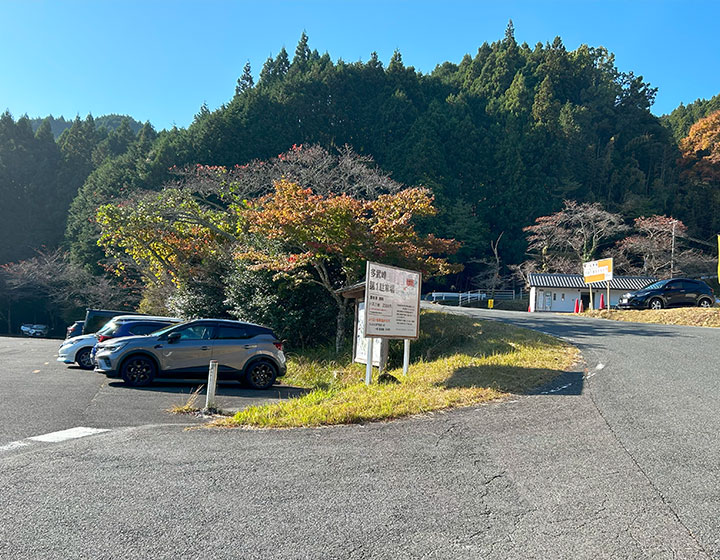
- November 3, 2023. I arrived at the first parking lot of Tanzan Shrine at 9:00 AM.
Access to Tanzan Shrine is either by community bus from Kintetsu/JR Sakurai Station or by car. This time, I visited by private car.
(There’s also a hiking course between Asuka Village and Tōno Mine Peak… but we’ll skip that for now.)
There are five parking lots around Tanzan Shrine, with a combined capacity of about 200 vehicles. The first parking lot is the largest.
Although it was still early for autumn colors, only a few cars were parked in the first lot by 9:00 AM.
As you exit the parking lot, a sign for the Tanzan Shrine walking entrance is directly across the road.
This is a shortcut toward Tanzan Shrine, accessed via stairs. Handrails are provided, but the stairs are somewhat steep.
The grounds of Tanzan Shrine feature many stairs and slopes, so please wear footwear suitable for walking, such as sneakers.
Additionally, the only paid parking lot, Lot 5th, is located closest to the entrance of Tanzan Shrine and features only a gentle slope.
For those with mobility issues, we recommend using the 5th parking lot, though it is a paid service.
 The pedestrian entrance leading from the 1st parking lot to Tanzan Shrine.
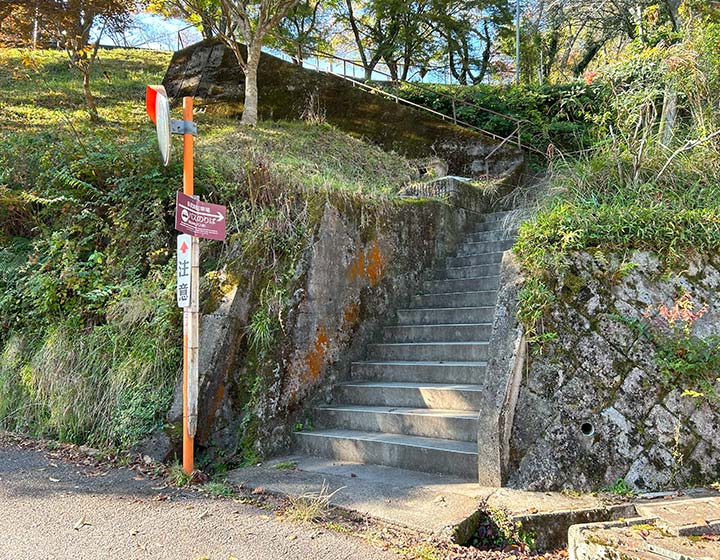 There are some handrails, but the stairs are a bit steep. Please watch your step.
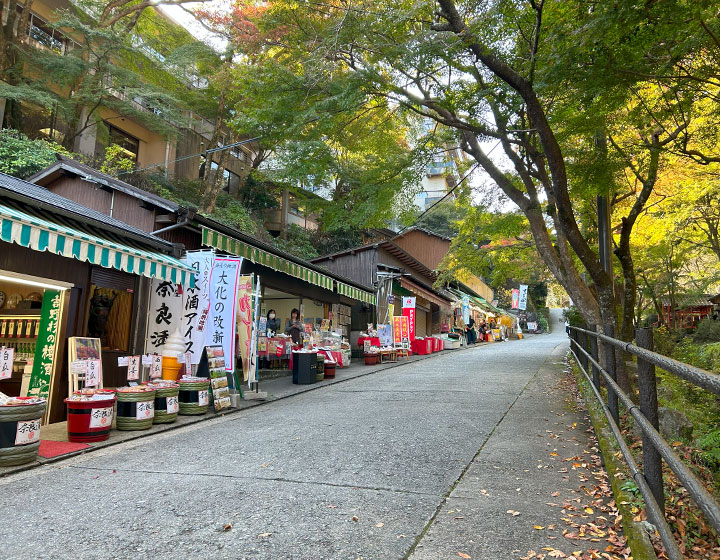 The approach to Tanzan Shrine. Full of enchantment.
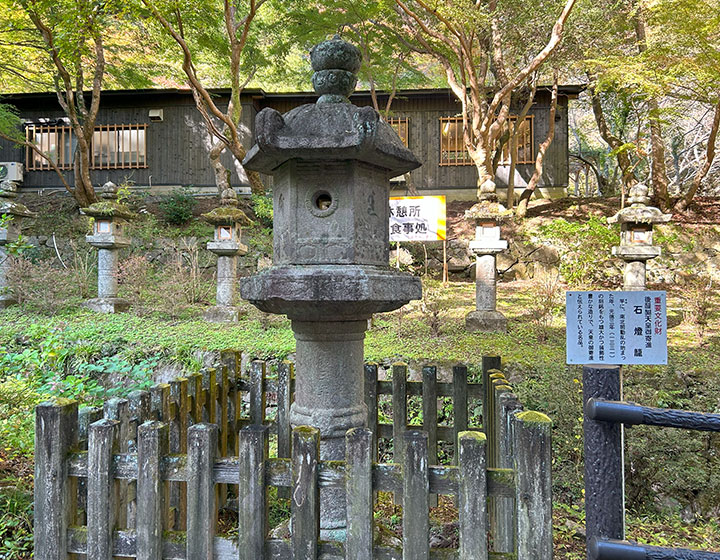
- This is a stone lantern along the approach path.
Important Cultural Property: Stone Lanterns Dedicated by Emperor Go-Daigo
This magnificent and richly ornamented pole, bearing an inscription dating to the year 1331, the third year of the Gentoku era when the Northern and Southern Courts turmoil began, is a renowned masterpiece said to have been donated by the Emperor.
Tanzan Shrine
It’s surprisingly rich in history despite its understated appearance.
From Parking Lot 1, it’s about a 5-minute walk to the entrance of Tanzan Shrine. Admission is 600 yen per adult. You can watch the Kemari Festival for this admission fee alone.
Upon entering the shrine grounds, you’ll receive a plastic bag to store your shoes when entering the worship hall and the shrine’s main sanctuary. Then, you pass through the large torii gate.
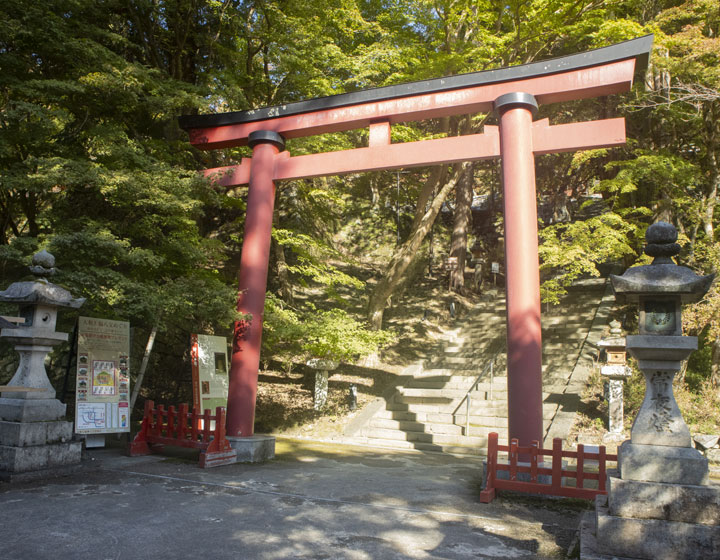
Tanzan Shrine Great Torii Gate
Off to “Mariniwa” right away.
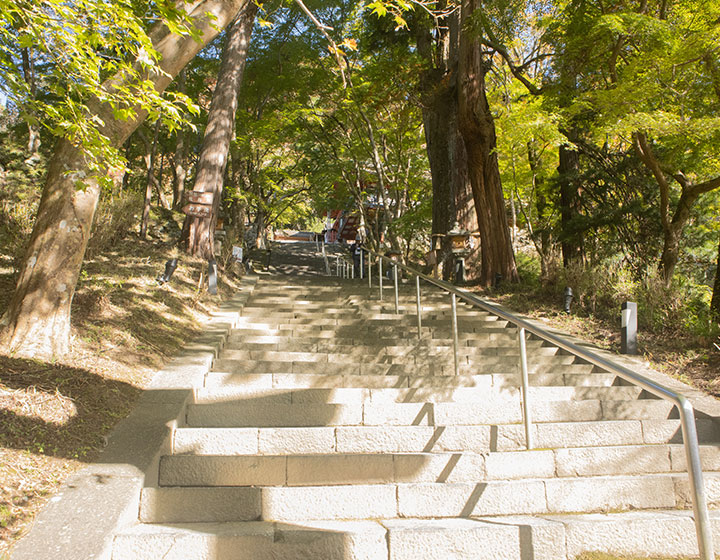
Tanzan Shrine Main Staircase
The vast Tanzan Shrine. Passing through the large torii gate, you’ll find the main staircase with about 140 steps. Climbing these brings you to the worship hall of Tanzan Shrine.
This time, I turned left partway up the stairs and headed toward the kemari ritual ground on the western side of the shrine grounds.
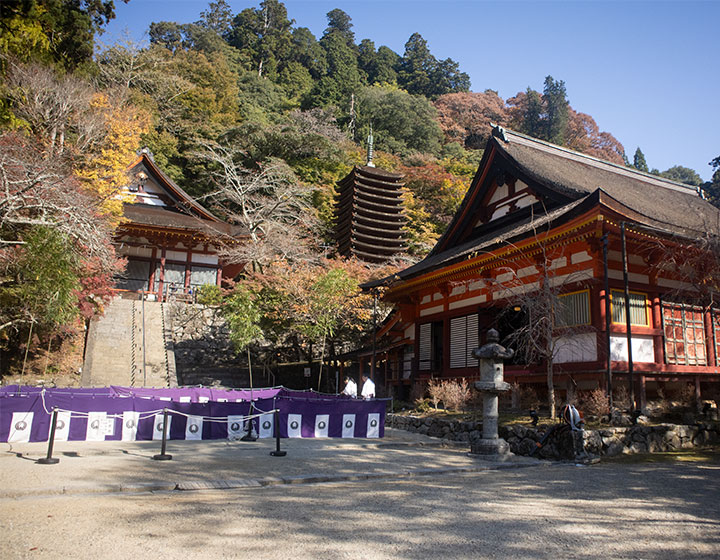
The Mariniwa. It should look even more beautiful once the autumn colors advance a bit further.
Arrived at the festival grounds. The curtains for the kemari game had already been set up, and the Mariniwa (a field for playing kemari) was prepared. Perhaps because it was still early, only a few people were scattered about.
This location features a photography stand from which you can capture three Important Cultural Properties within a single frame: the Thirteen-Story Pagoda, the Shrine Worship Area (formerly the Lecture Hall), and the Kōtokuden Hall.
Some people had large cameras in hand, and after chatting briefly with the tourists, I decided to go pay my respects at the main hall for the time being.
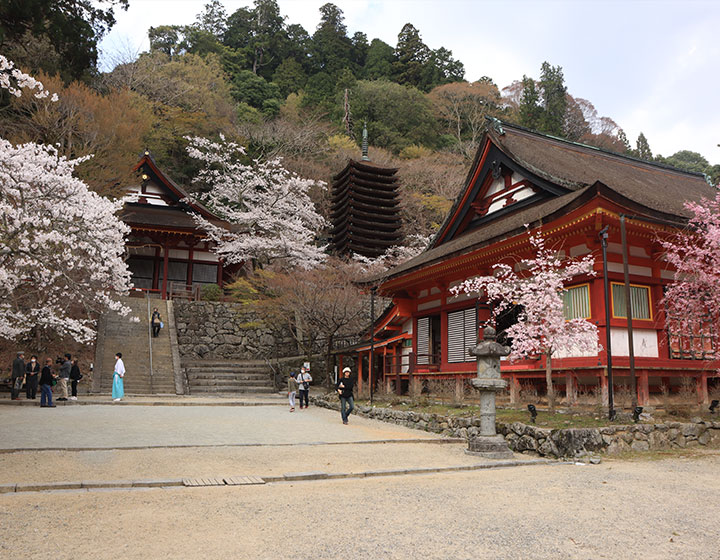
The usual spring scene. Cherry blossoms grace the garden with vibrant beauty, but by the time of the Kemari Festival, fresh green leaves emerge.
Worship at the main hall.
I walk the path from the Mariniwa to the worship hall.
This path is part of the route where, later during the Kemari Festival, the priests of Tanzan Shrine and the kemari players from the Kemari Preservation Society form a procession and march from the shrine office to the main hall.
By the time the festival begins, people are already staking out spots to photograph the kemari, so I can’t see the ritual held at the main hall. Therefore, I walked the same route just to get the same feeling.
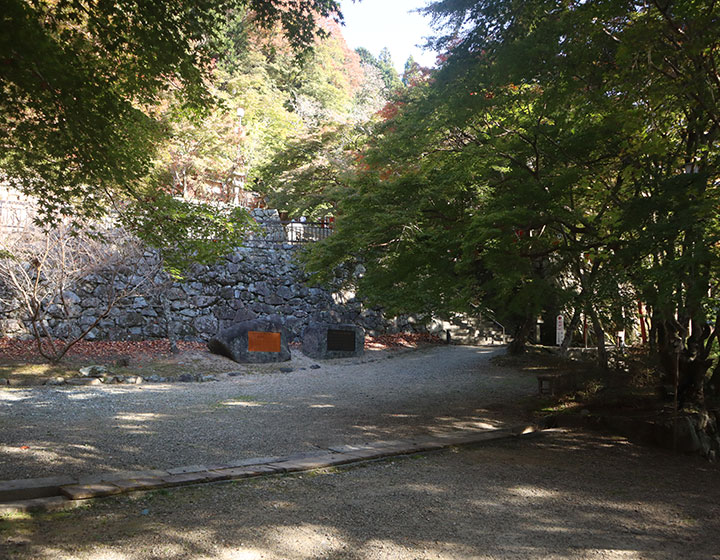 The weather was exceptionally fine that day, with a summer-like forecast despite it being November.
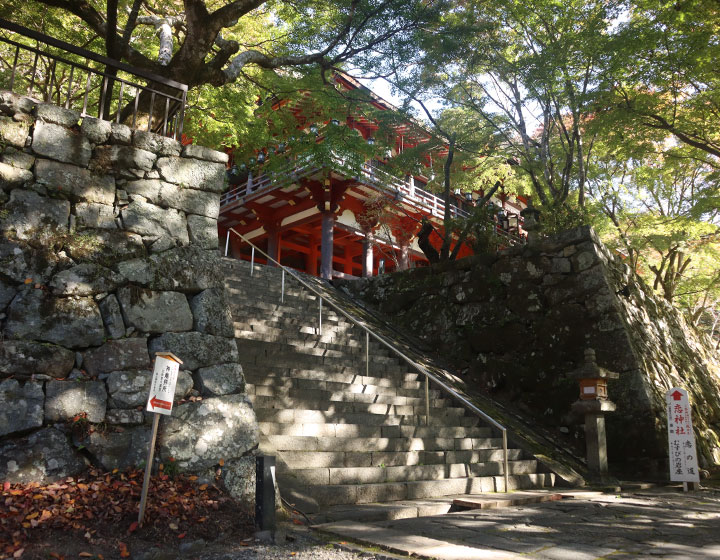 Near the top of the main staircase. The vermilion-lacquered stage-style worship hall can be seen just above.
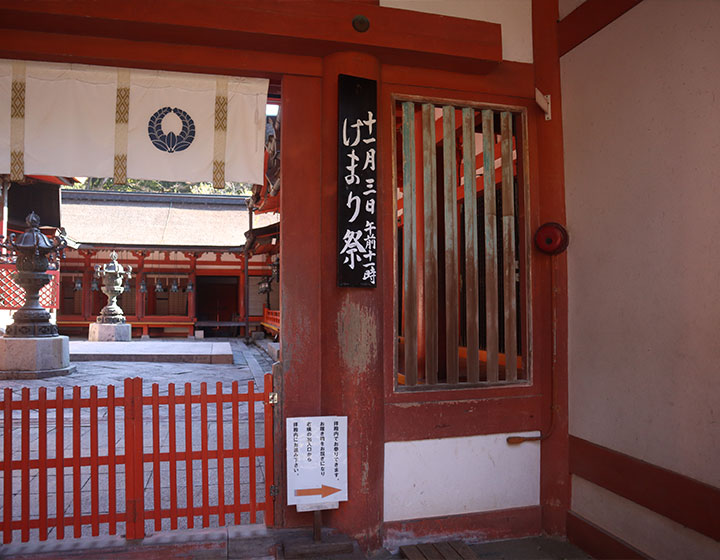 A sign announcing the upcoming Kemari Festival was posted at the gate.
Place your shoes in the bag provided at the entrance and proceed to the main hall.
The worship hall is a vermilion-lacquered stage-style structure founded in 1520. Its central ceiling is crafted from Kyara(agarwood), earning it the name “The Thousand-Tatami Agarwood Chamber.”
The curved east-west open corridor (a corridor with no walls on either side, consisting only of pillars and railings) forms a unique structure encircling the main hall.
Tanzan Shrine was featured in a JR Central commercial, and the beautiful blue maple leaves visible from the worship hall became a hot topic.
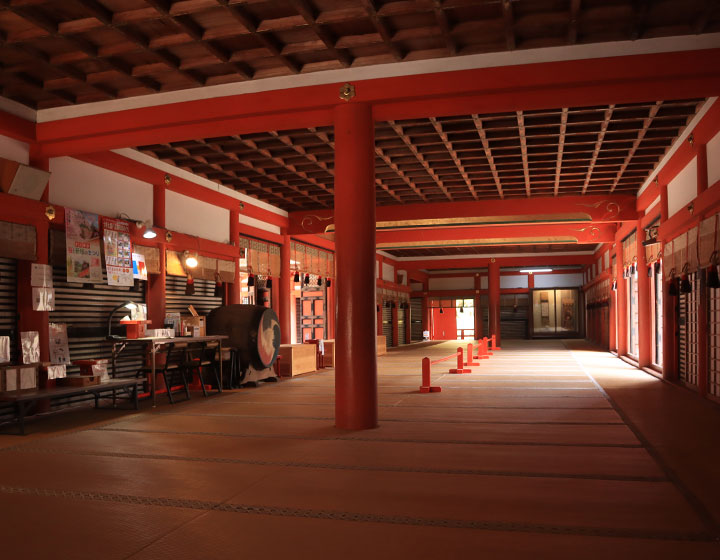 Inside the worship hall. Exhibits featuring episodes and materials related to Fujiwara no Kamatari are also on display.
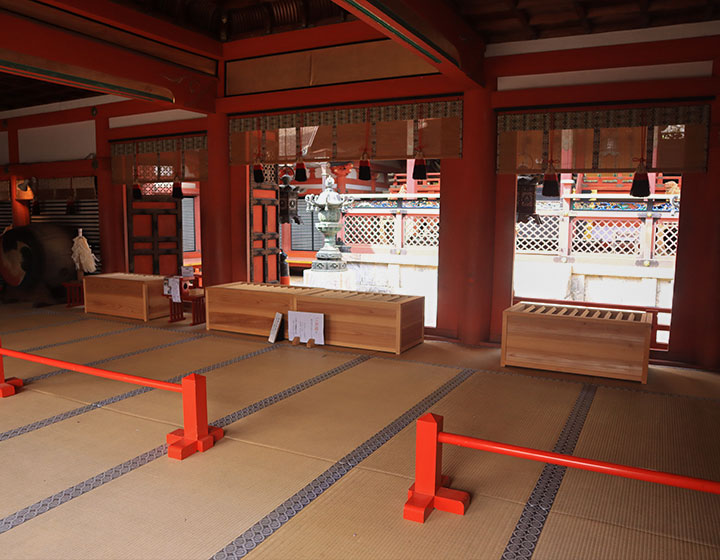 I proceed from the worship hall to the main shrine for worship.
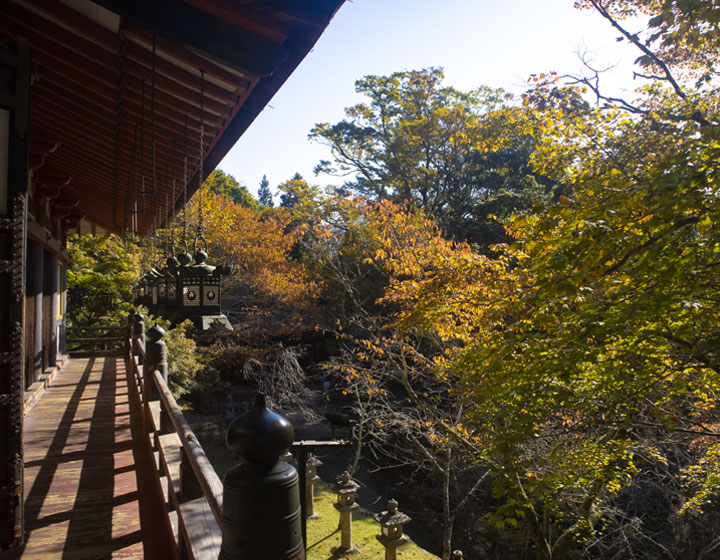 Copper hanging lanterns are suspended in the open-air corridor.
Inside the worship hall, you can view treasures and materials such as the previously mentioned “Tōno Mine Engi Emaki.”
Among them, a “Kemari ball” was displayed!
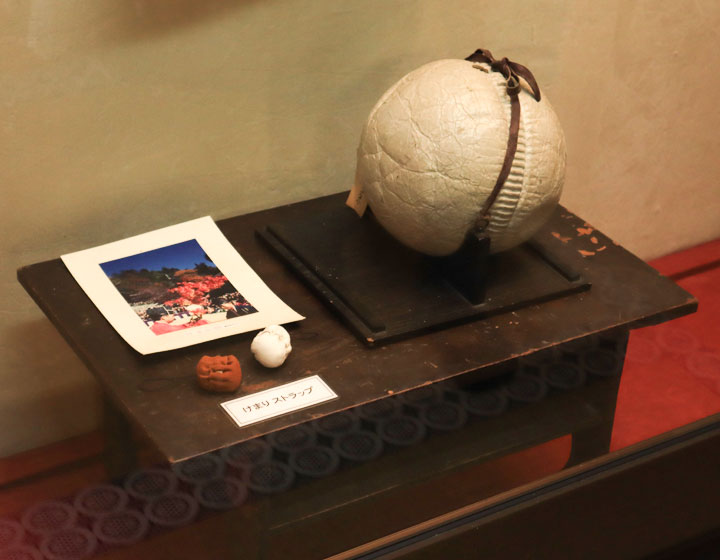
A strap featuring a small kemari ball. I’m curious about how it feels to the touch.
The ball used for kemari is made by sewing together two pieces of deer hide with horseback leather, then finished pure white with gofun (a pigment made from crushed seashells).
Size is about 17 to 18 cm, and weight is about 100 to 110 grams.
There is no compressed air inside, unlike in volleyballs or basketballs.
It’s more like a paper balloon made of leather.
In fact, around the 1950s, the craft faced a crisis where makers of kemari balls nearly disappeared. The balls used at Tanzan Shrine are now produced by the Tanzan Kemari Workshop in Sakurai-shi.
With no documented methods for making the kemari ball, its restoration has been a trial-and-error process.
They repeatedly stuffed barley into the kemari ball, removed it, reshaped it, and adjusted it to ensure it didn’t lose too much air and bounced well.
An ancient game that has passed through periods of prosperity and decline, carrying its traditions into the modern era. The thought of seeing it up close fills me with excitement!
It was already around 9:40 AM. I decided it was time to head back to the garden.
Until the Kemari Festival begins.
The Japanese historical kemari festival begins at 11:00 AM. First, a procession arrives from in front of the shrine office, passes through the kemari field, and performs a notification ceremony at the main shrine.
Afterwards, the procession returns to the kemari field, and the kemari game begins around 11:30 AM.
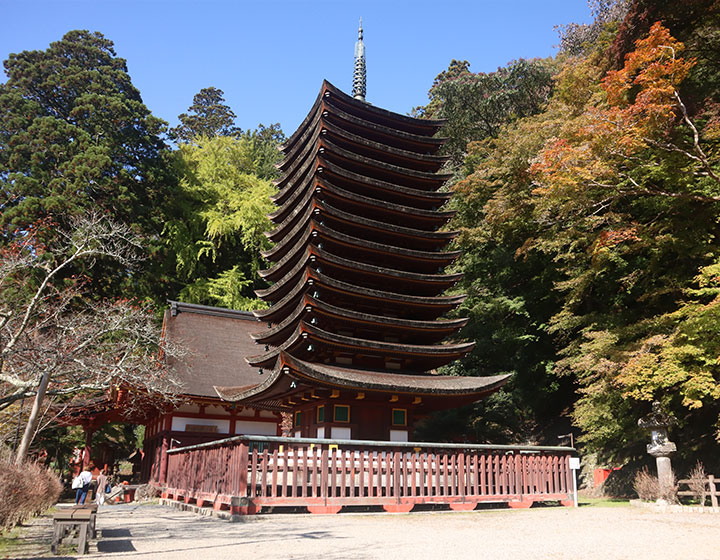
While viewing the thirteen-story pagoda along the way…
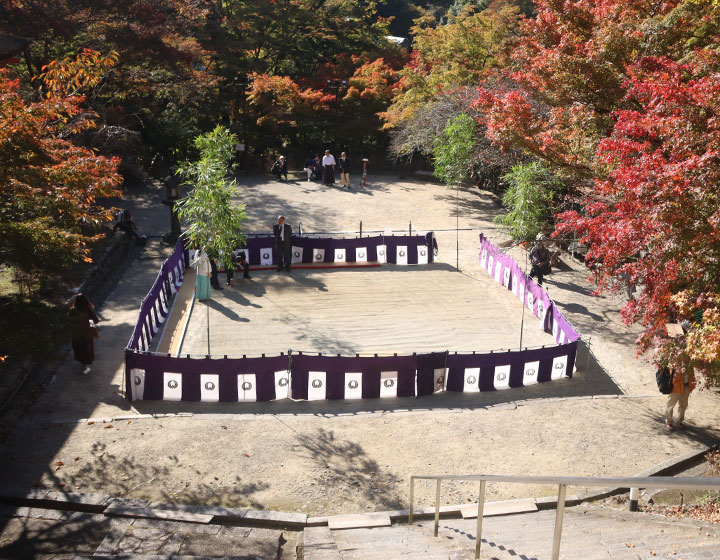
From the steps before the Gonden to the kemari festival grounds.
Spectators around us seem to share the same impression—the area covered by the curtains appears surprisingly small.
If you think of it as a place for sports, it certainly feels cramped, but kemari has no winners or losers.
It’s considered good to kick the ball back and forth gracefully, making it easy for the opponent to return the kick, and to keep the rally going for a long time. It’s said to be a way to share enjoyable moments together.
It’s more like a game or play than a competition.
The field where kemari is played is also called a maru-niwa, maru-tsubo, or kagari. Sand is spread over the ground, and traditionally, cherry trees are planted in the northeast, willows in the southeast, maples in the southwest, and pines in the northwest at the four corners.
This is called the Motoki (also known as Shiki-no-ki), and its height is set at no more than one jō five shaku (approximately 4.5 m). It serves as a reference point for the height at which the ball is kicked upward.
Here, cut green bamboo is set upright as a simple substitute.
After circling around the Mariniwa once more, the shrine priest kindly pointed out recommended viewing spots for the kemari match. After pondering various things…
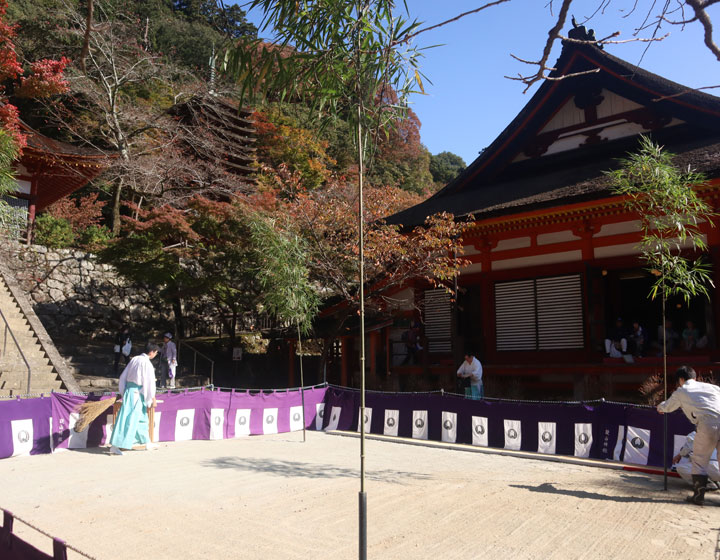
I’ve decided!
Photography is permitted in the free areas around the Mariniwa as long as it does not obstruct festival staff or pathways. However, the south side is reserved for television crews, newspaper companies, and other designated seating areas.
Therefore, I decided to view it from this spot on the west side, where the “Thirteen-Story Pagoda,” “Shrine Worship Area,” and barely the “Gonden Hall” fit within the frame.
This spot offered no shade, making it seem like the harshest place on a day forecast for summer heat, but it promised the chance to capture photos of the kemari against the backdrop of the beautiful temple grounds.
By the way, the shrine priest recommended the shaded side near the shrine worship area.
Moreover, if you sit on the veranda of the shrine worship area, you can watch the kemari from a slightly elevated vantage point.
Now that I’ve finished sightseeing, I can definitely recommend this spot… but this time, I wanted to photograph the thirteen-story pagoda together, so I decided to endure the sunlight and wait for the festival to begin.
It was just before 10 :00 AM. The priests were preparing the site, picking small stones out of the sand and such. People were gradually gathering, but it still felt like the crowd was just getting started.
30 minutes later.
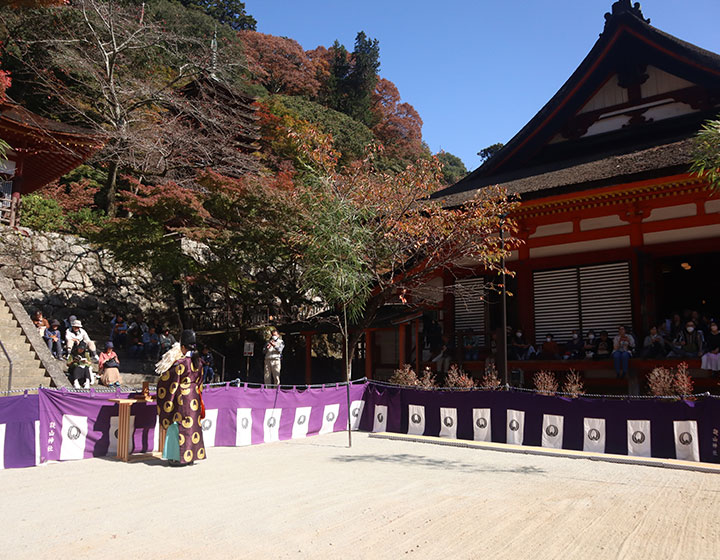
It’s getting crowded.
Around 10:30 AM, the Shinto priest came to enshrine the Onusa (One of the instruments used for purification at religious services of Shinto) on the Kamidana (Shinto altar).
It seems like the number of sightseers has suddenly increased since a little while ago. Perhaps those arriving by bus from Sakurai Station have just gotten here.
People lined up along the veranda of the popular shrine viewing spot, and others sat on the steps waiting for the start of the Kemari game.
Off-camera, crews from multiple television stations were busy preparing, indicating the high level of attention the Kemari Festival attracts.
Watch the spectacular kemari!
The festival begins.
As time passed, it was just before 11 :00 AM.
Sweating under the unseasonably intense sun and heat, a single firecracker-like sound rose from the shrine office, and the procession began, led by the musicians.
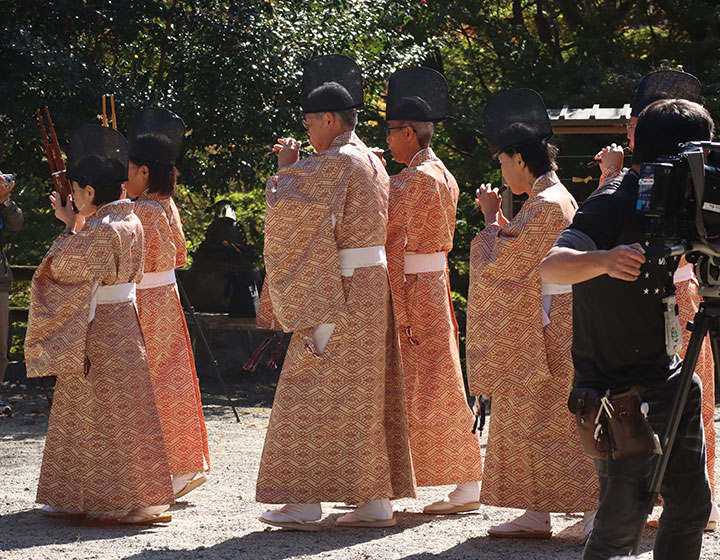 The solemn sounds of gagaku music performed by musicians resonate throughout the temple grounds.
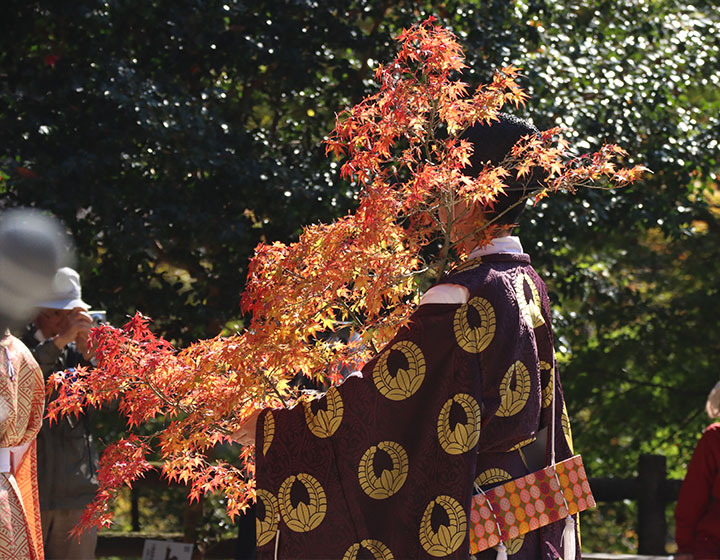 Next comes the priest of Tanzan Shrine, holding a maple branch with a kemari ball tied to it.
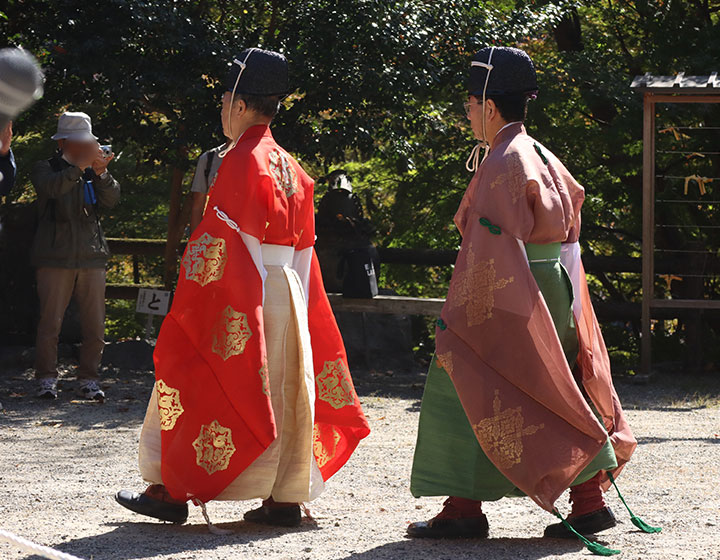 Following behind them came the players who would be participating in today’s kemari match.
The dedication ceremony will now begin at the main shrine.
I’d like to follow the procession, but my purpose today is kemari.
I’ll wait here for a while until the dedication ceremony ends and the procession returns.
Around 11:40, the procession returned to the Mariniwa. The kemari was about to begin!
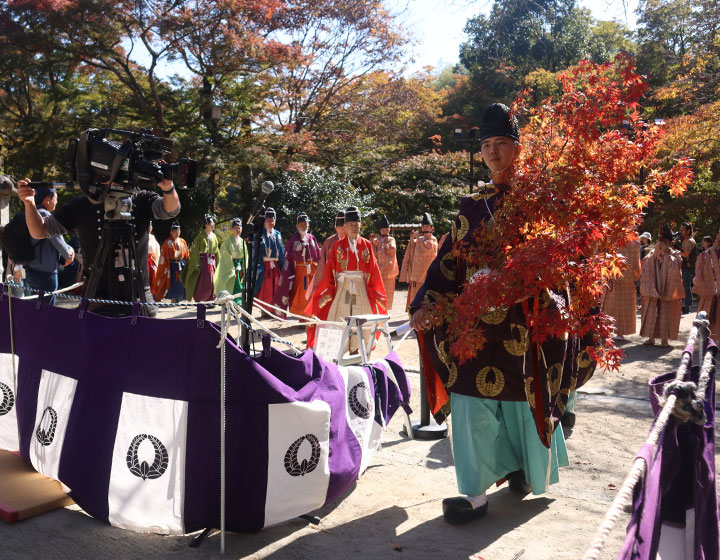 The priest holding the kemari ball leads the way into the curtain.
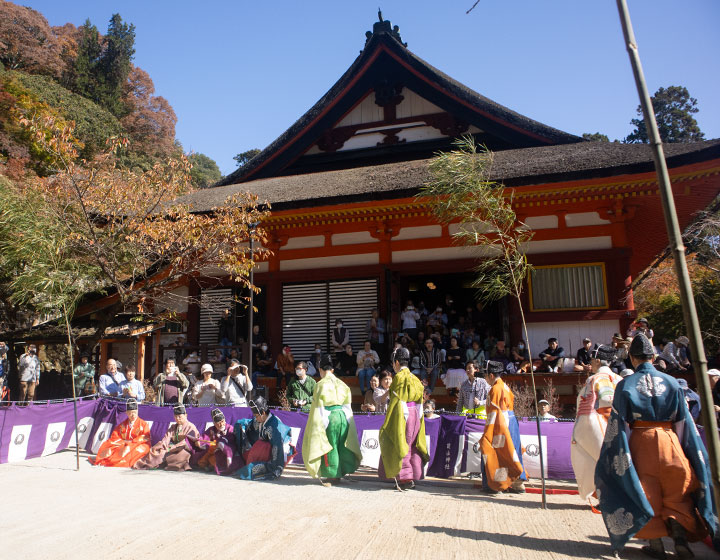 Next, the players enter.
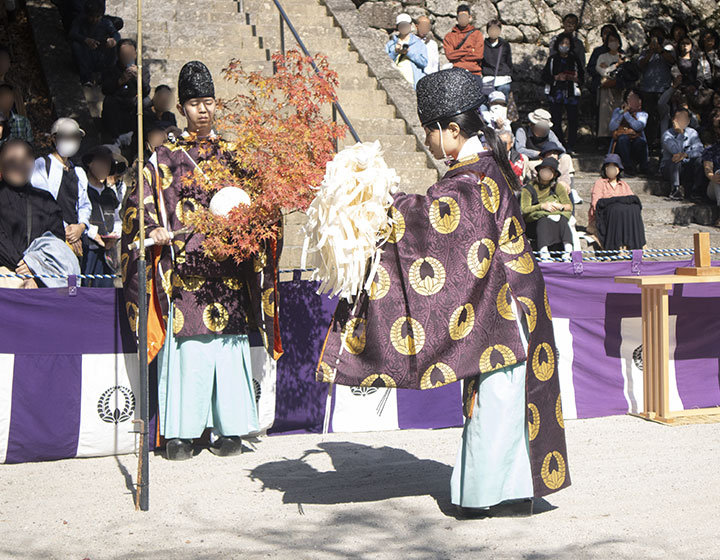 After reciting the prayer at the kamidana, purify the four directions with the Onusa.
The Unraveling of the Ball Ceremony.
Mariashi(Kemari player) dressed in traditional ceremonial attire take their seats in order of rank, beginning with the highest-ranking individuals.
The Kemari costume consists of a Eboshi(hat), Mari-Suikan(tops), Mari-hakama(bottoms), and shoes. It is a strikingly colorful and truly elegant ensemble.
Actually, until the 16th century, there were no particular dress codes, and people enjoyed themselves casually in everyday clothes.
It is said that during the Heian period and later, court nobles often wore kariginu (originally considered clothing worn during hunting) for exercise. However, around the Muromachi period, the style evolved to feature a Choken (a Suikan made of stiffened silk) as the upper garment, Kuzuhakama as the lower garment, a tate-eboshi (a tall, pointed hat), and leather marigutsu (a type of shoe) worn with it.
It is a game that competes on how elegantly one can kick a ball into the air, so the sleeves of the vividly colored garments must have been designed to flutter like this to achieve the present form.
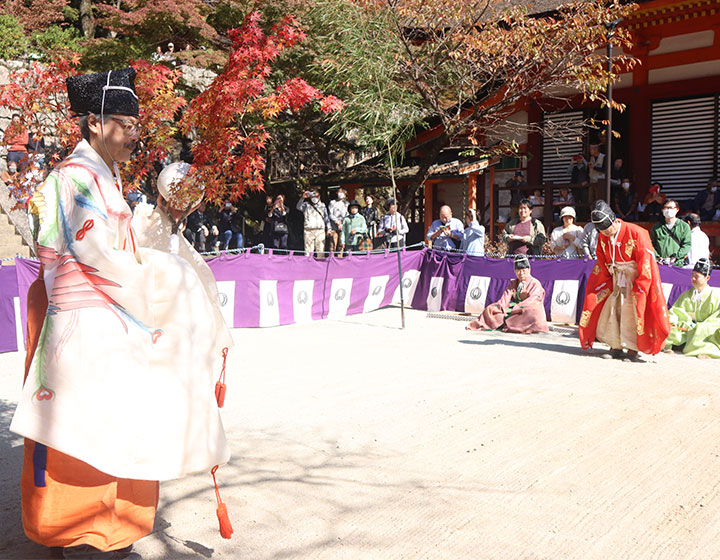
The Unraveling of the Mari ball Ceremony begins.
Now, the “Unraveling of the Mari ball Ceremony” has begun.
The person seated lower receives the ball tied to the maple branch from the priest, then passes it to the Noki (the highest-ranking leader among the ball players). The Noki unties and removes the ball from the maple branch.
When removing the Kemari ball from the branch, it is proper etiquette to conceal the action with the sleeve of your Suikan so that the act itself remains unseen.
After that, place it in the center of the Mariniwa.
The proper procedure is for the lowest-ranking person to approach diagonally from beneath the fourth tree, kneel about three steps from the center, advance on tiptoe, and place the ball in the center. However, this time, as an exception, the Noki performed the task.
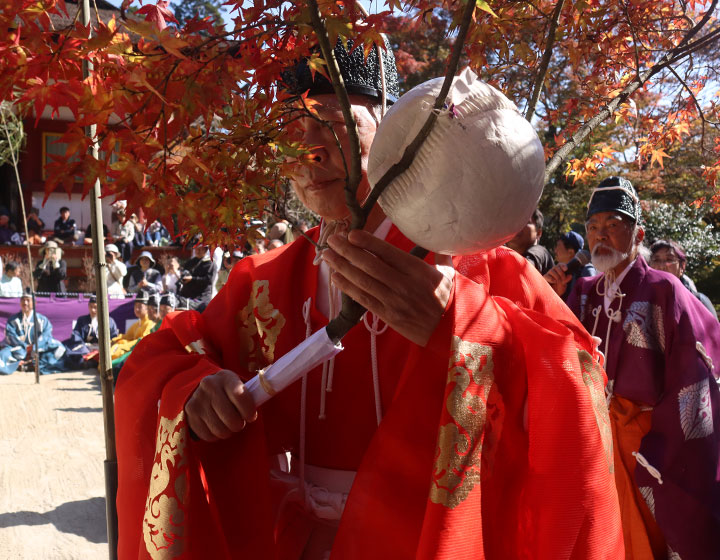 The Kemari ball tied to a maple branch.
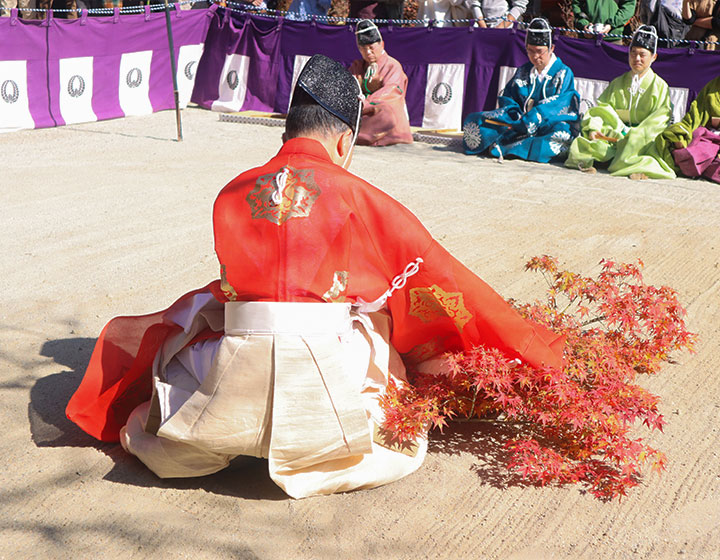 Removing the ball from the branch.
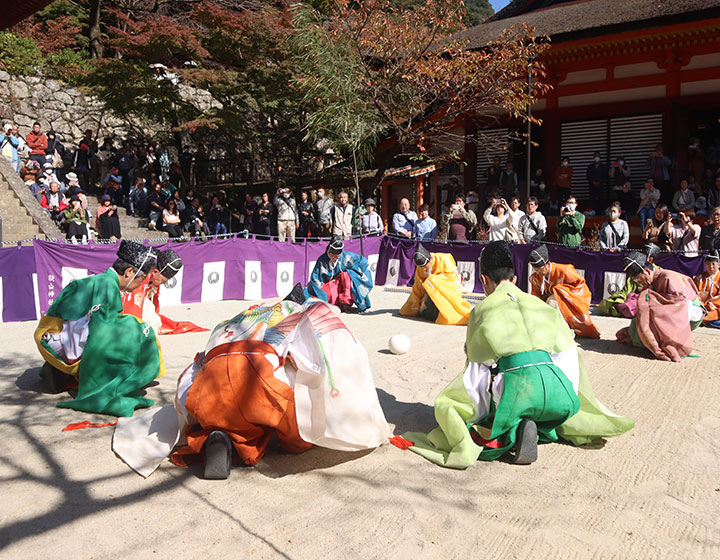 One by one, those of higher rank step forward and kneel around the ball.
Next, the Mariashi move around the ball in order of rank, kneeling as they go.
This time there are eight players.
Once everyone has taken their positions to form an octagon, Noki will start kicking the ball in turn.
This is what you might call a warm-up, checking the ball’s kick and any quirks.
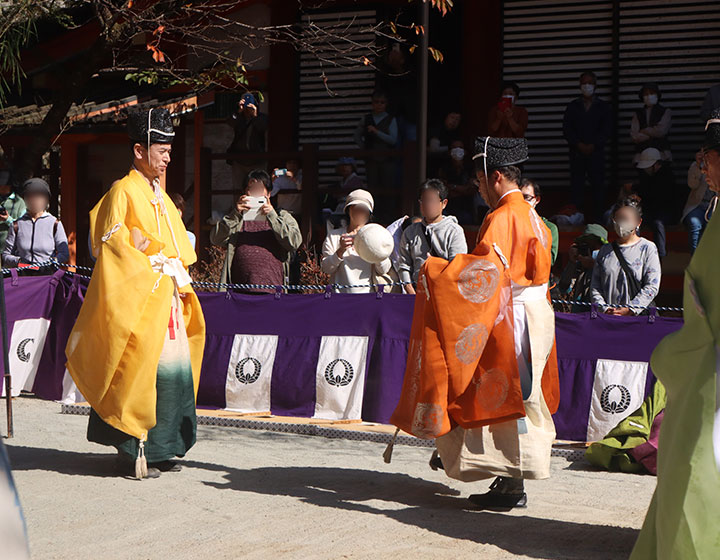 Taking the ball in hand and letting it go…
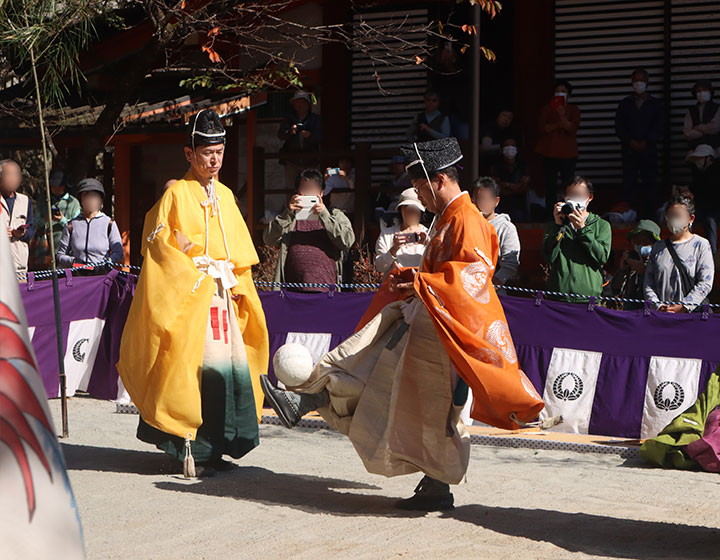 One kick.
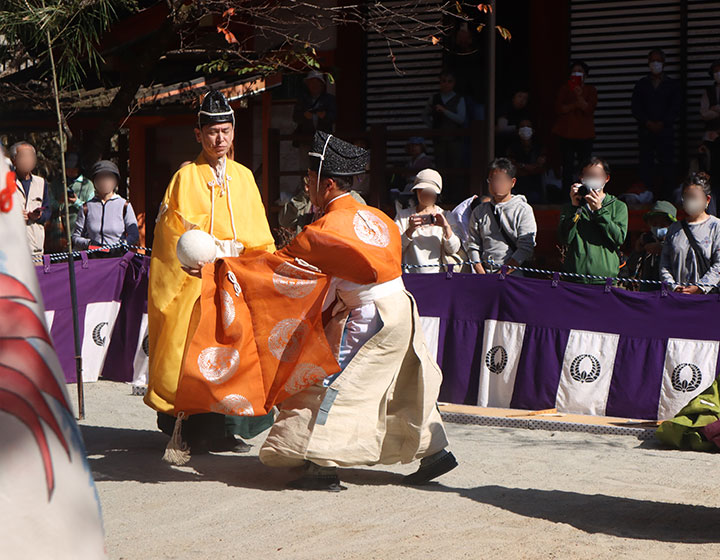 Catch it by hand. This will be done one person at a time.
Each person kicks the ball in turn, passing it to the next person until only one person remains.
Showtime!
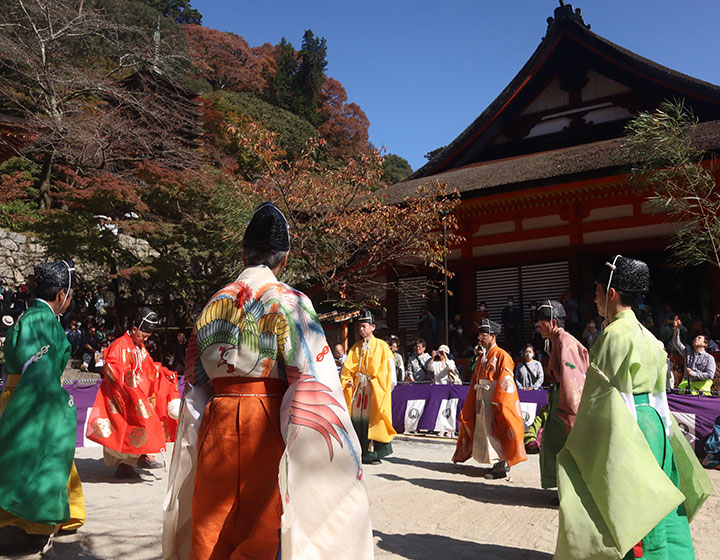 Huh?
Huh?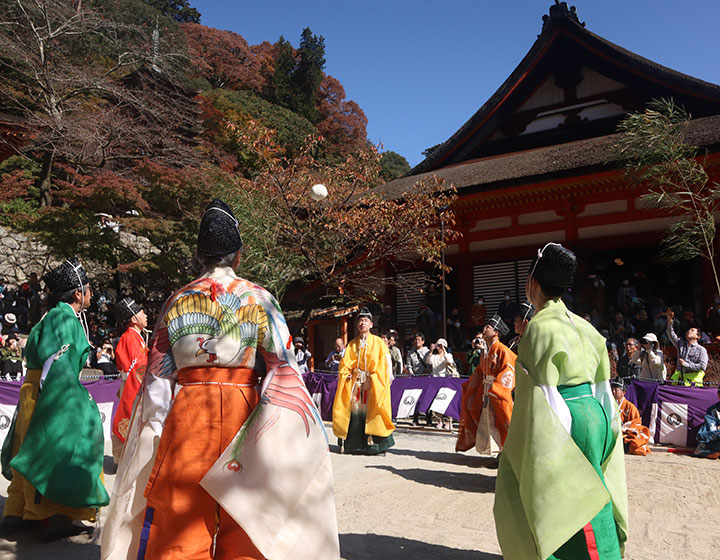 Oh, did it just start?
Noki kicked the ball upward with the shout “Ariyah,” and the match began!
There was no signal for “Let’s begin,” so I was startled when the game suddenly began.
At first, the rally would connect once or twice before the ball rolled away. If the ball fell, someone nearby would pick it up, reshape it, and restart play.
The ball is made like a paper balloon, so kicking it causes it to dent. Kicking it again makes the dented part spring back, causing the kicked part to dent. This cycle repeats.
The sight of a white ball soaring high into the blue sky is a refreshingly elegant spectacle.
However, since the field is covered in sand, it kicks up an incredible amount of dust.
I was standing just slightly off the downwind side, but it was a windy day, and at times I couldn’t even keep my eyes open.
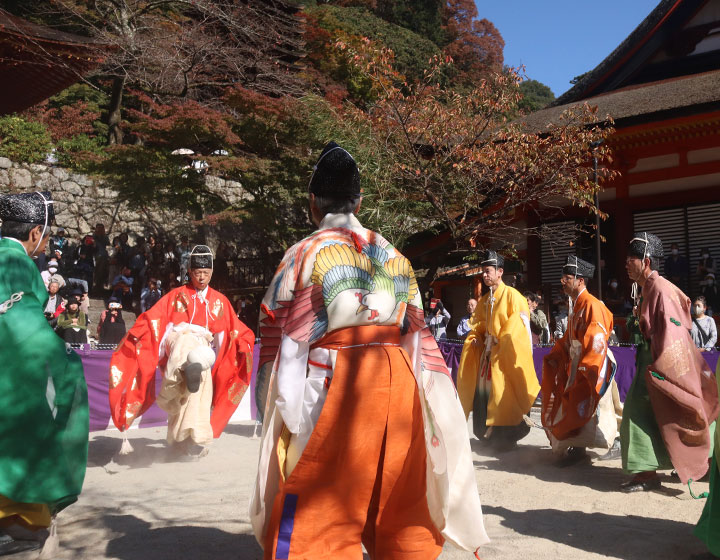
A cloud of dust billows up at Noki’s feet (the one in the red top).
The individuals playing kemari are members of the Kemari Preservation Society, which has been active in Kyoto Prefecture since 1907.
One of them will hold the microphone and provide live commentary, sharing various insights about the game.
He stated, “I do not possess the skill to play without kicking up dust.”
The game continues amid lighthearted kemari talk laced with jokes.
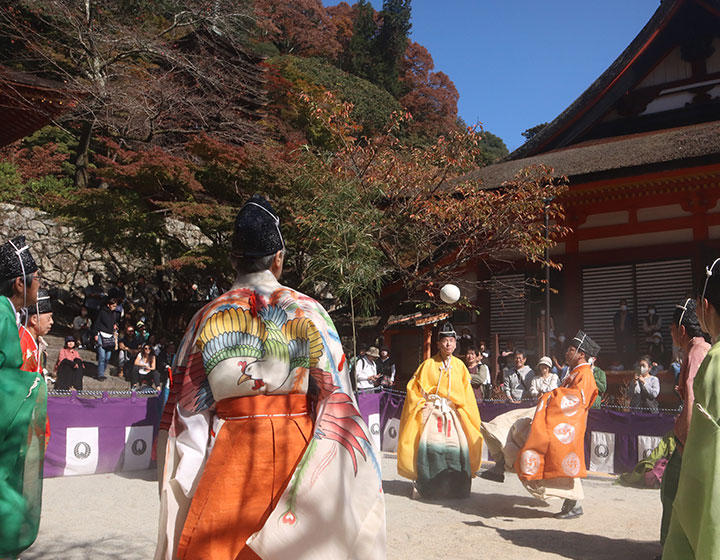
He stated, “I do not possess the skill to play without kicking up dust.” The game continues amid lighthearted kemari talk laced with jokes.
There are various rules and etiquette for kemari.
This kemari match features eight players. This formation is called “Hakkyō,” where the field is divided into eight sections from the center. Each player is assigned one section as their primary defensive zone. If the ball is kicked outside their zone, the player in that zone receives and kicks it.
Rather than just defending your own zone, you must keep moving aggressively to fill every open space, demanding far more aggressive movement than you might imagine.
When kicking, use only the instep of your right foot, keep your upper body still, do not bend your knee, and kick in such a way as to avoid showing the sole of your foot as much as possible. The rules and etiquette are defined in considerable detail.
Particularly interesting is the practice of shouting “Ari!”, “Yah!”, “Oh!”.
“Yah” and ‘Oh’ are still familiar today, but don’t you think the call “Ari” is unusual?
These shouts originated from Fujiwara no Narimichi, a master of kemari who lived in the late Heian period.
Fujiwara no Narimichi possessed every talent imaginable, and his skill in kemari was so extraordinary that even later generations recounted his incredible feats, earning him the title of “Kemari Saint.”
At one time, Narimichi undertook a thousand-day practice of playing kemari without rest to improve his skill, and he accomplished it.
That night, a ball spirit appeared before Narimichi in the form of a child around three or four years old.
They were said to have human faces, but their hands, feet, and bodies were those of monkeys.
Their names are “Ge-an-rin” “Syun-You-ka,” and “Syu-on,” and this is the origin of the chant.
Next, the second game.
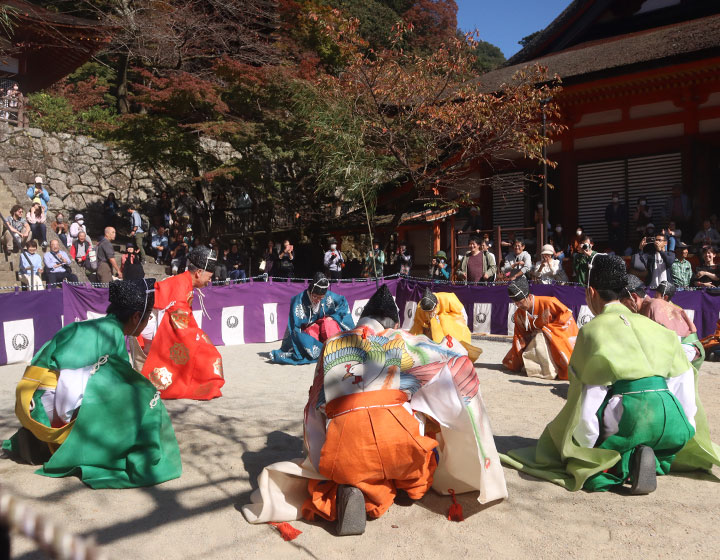
The game of kemari continued for a while. Then, at one point, Noki returned the ball to the center of the playing field, and the players once again formed a circle around it and knelt.
This concludes the kemari match.Just as at the start, the players will exit one by one.
Noki decides when to end the kemari game.
When a member of the Kemari Preservation Society said, “It ends when Noki gets tired or hungry,” laughter and applause erupted from the audience.
From the start of the kemari match following the “Unbinding of the Ball Ceremony” until its conclusion, the entire event lasted just under fifteen minutes.
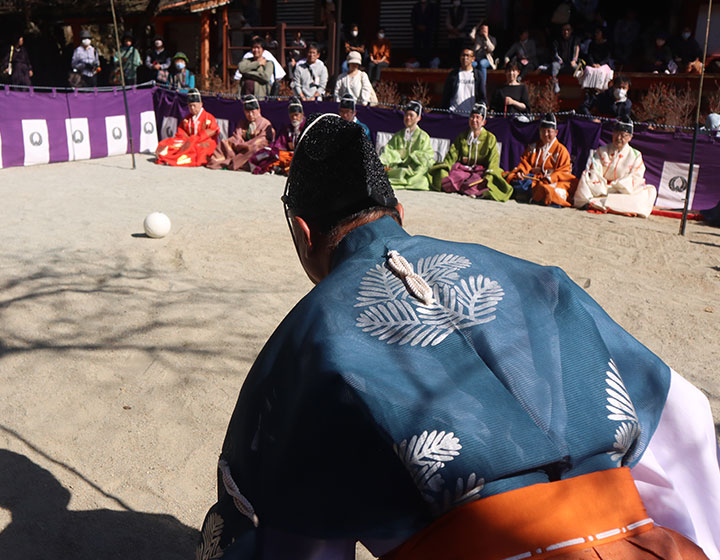
The 2nd session begins with a change in members.
Once again, they kneel around the ball in order from the highest seat, and after everyone checks the ball’s bounce, the game of kemari begins anew.
Even as a novice photographer, I’ve gradually gotten the hang of capturing the moment when the ball is flying high.
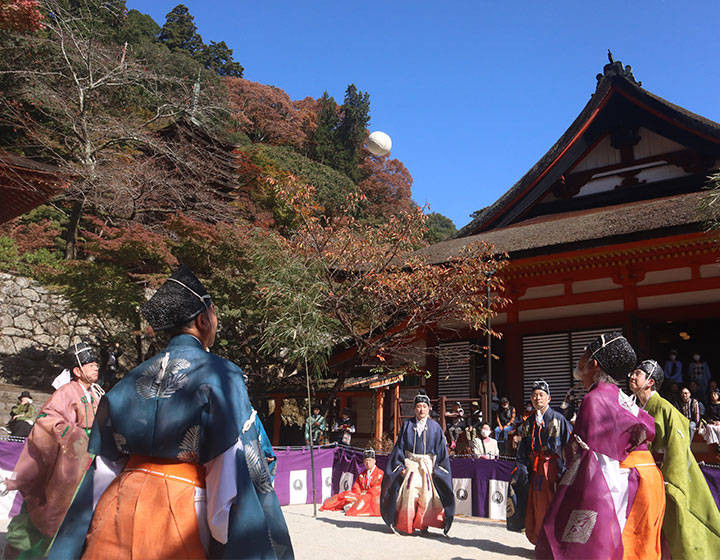 The ball is flying high!
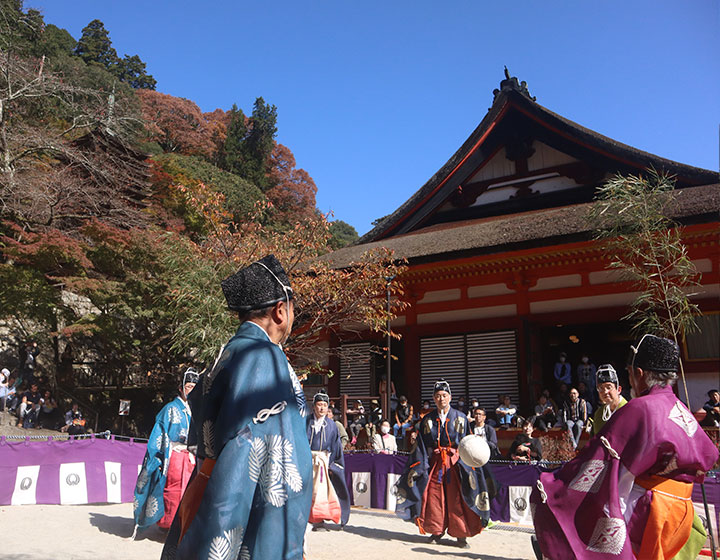 Receive the falling ball.
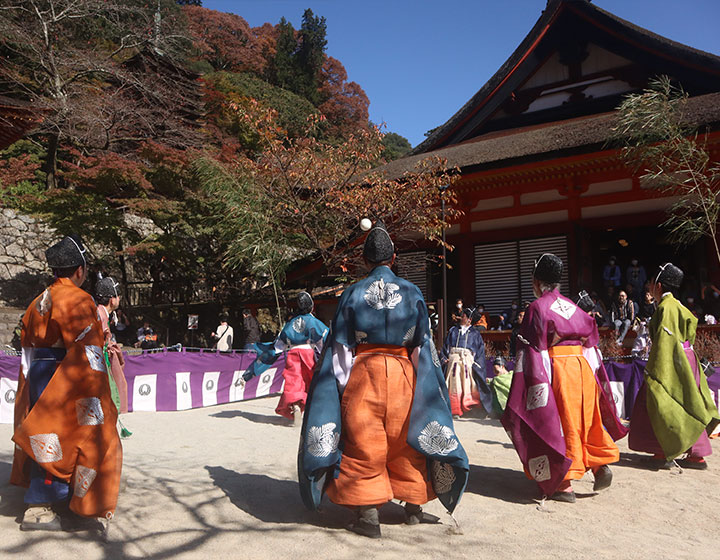 The ball often flies out of the Mariniwa with too much force.
The ball’s trajectory gradually improves, rising higher and drawing cheers from the crowd.
When the ball comes close and the player kicks it up, it feels incredibly real.
The kemari ball is hollow inside like a paper balloon, but the sound it makes when kicked—a deep, heavy thud like a soccer ball—was truly impressive!
 The ball used continuously from the first seat has developed a sort of indentation.
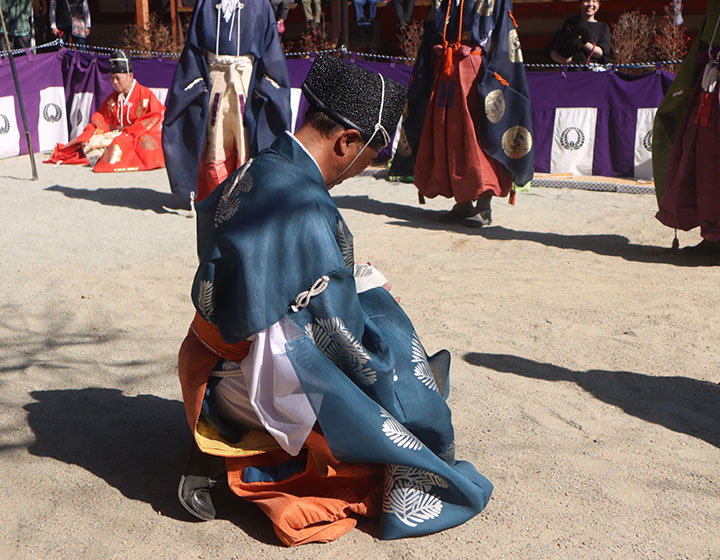 Pick up the deeply dented ball.
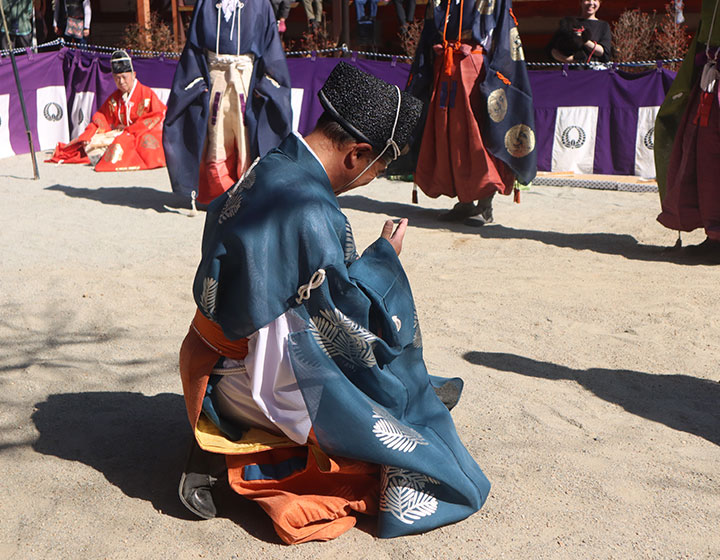 Gently tapping it back into shape.
The second match also wrapped up in just under 15 min. And just like that, the kemari viewing came to an end in the blink of an eye.
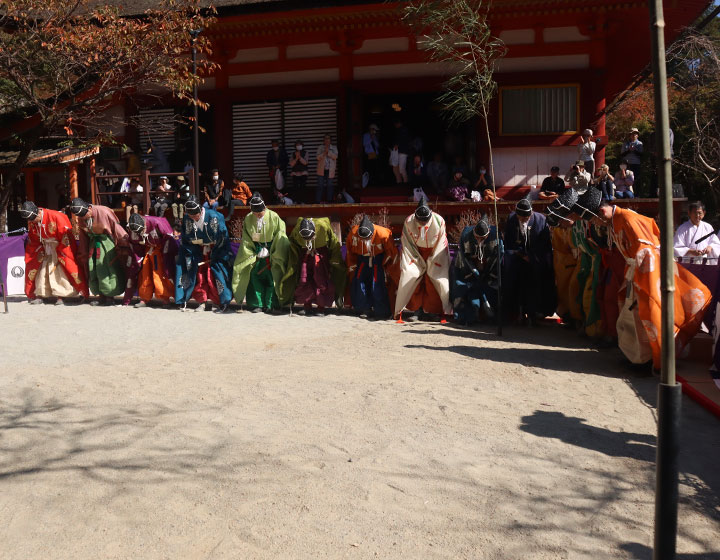
Everyone at Mariashi, thank you for your hard work.
It was an extremely hot day with intense sunlight, but the weather was absolutely perfect.
Dragonflies swarmed over the Mariniwa garden, where the unique calls of the Mariashi, the bouncing kemari balls, and the leisurely dragonflies gliding through the air created an exceptionally elegant and otherworldly scene. The beautiful grounds of Tanzan Shrine made for a truly precious viewing experience.
If I could wish for anything, it would be for the autumn leaves to be just a little more advanced… I’d love to go see the autumn kemari festival again! I gazed longingly at Mariniwa after the kemari match ended.
Access
Now, regarding access to Tanzan Shrine, we recommend using a car or taxi from the Asuka Village area.
Using public transportation would involve quite a detour.
From Tanzan Shrine to the Ishibutai Tumuls in Asuka Village, there is a hiking course that takes about an hour and serves as the descent route from the mountain.
The route passes through some road sections and dense wooded areas, but it also features Asuka Village’s beautiful terraced rice fields and the lush, moss-covered Kitsuwaki Shrine. It’s a popular hiking course during the pleasant seasons.
How about taking a taxi on the way up and hiking down on the way back for a fun descent?
Location of Tanzan Shrine
Tanzan Shrine Official Website
Related Articles
ブログ Blog
sangimi no yado ブログ
-

Water Art Festival 2025 : Enjoy water-themed art experiences in Mizuma Monzen-machi
2025.10.1
A new art project in Mizuma, a town that has lived alongside two rivers! The Kogigawa River, originating from …
 Autumn Highlights / Cafe / Event / Festival / Food / Gourmet / green space / heritage attraction / hiking / Kaizuka-shi / Mizuma no yado / Osaka / park / Rural Japan / shrines and temples
 -

Tanzan Shrine’s Kemari Festival [Plenty of Photos! ]
2025.9.9
Cherry blossoms in spring, Maple leaves in autumn. A white ball dances in the elegant garden. Tanzan Shrine, a…
Asuka no yado / Autumn Highlights / Event / Festival / green space / heritage attraction / hiking / History of Japan / Mahoro no yado / Nara prefecture / Popular Sights / Rural Japan / Sakurai-shi / shrines and temples / Spring Highlights -

Recommended Gourmet / Spots in Kaizuka-shi & Surrounding Area
2025.9.3
Rich history and bountiful mountain produce and seafood. Kaizuka-shi and its surrounding notable spots The Sen…

